implementation of factory for objects of type T using a constructor with two arguments of types CA1 and CA2 More...
#include <register.h>
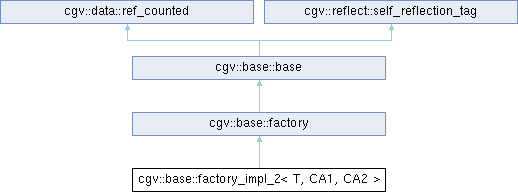
Public Member Functions | |
| factory_impl_2 (CA1 _ca1, CA2 _ca2, const std::string &_created_type_name, bool is_singleton=false, const std::string &_object_options="") | |
| base_ptr | create_object_impl () |
| overload to create an object | |
| std::string | get_type_name () const |
| overload to return the type name of this object. By default the type interface is queried over get_type. | |
| Public Member Functions inherited from cgv::base::factory | |
| factory (const std::string &_created_type_name, bool _singleton=false, const std::string &_object_options="") | |
| construct | |
| virtual std::string | get_object_options () const |
| return the options string used for object registration | |
| const std::string & | get_created_type_name () const |
| overload to return the type name of the objects that the factory can create | |
| std::string | get_property_declarations () |
| support creation of object by setting create property to true | |
| bool | set_void (const std::string &property, const std::string &value_type, const void *value_ptr) |
| abstract interface for the setter of a dynamic property. | |
| bool | get_void (const std::string &property, const std::string &value_type, void *value_ptr) |
| abstract interface for the getter of a dynamic property. | |
| bool | is_singleton_factory () const |
| return whether the factory can only generate one instance of the given type | |
| base_ptr | get_singleton () const |
| return pointer to singleton | |
| void | release_singleton () |
| release the singleton pointer | |
| base_ptr | create_object () |
| overload to create an object | |
| Public Member Functions inherited from cgv::base::base | |
| virtual std::string | get_default_options () const |
| overload to provide default options for registration | |
| std::string | get_name_or_type_name () const |
| determine name of instance by checking cgv::base::named interface and in failure fallback to get_type_name() | |
| virtual void | on_register () |
| overload to handle register events that is sent after the instance has been registered | |
| virtual void | unregister () |
| overload to handle unregistration of instances | |
| virtual bool | on_exit_request () |
| overload to handle the appication exit request, return true if exiting is allowed and false otherwise | |
| virtual void | stream_stats (std::ostream &) |
| overload to show the content of this object | |
| virtual data::ref_ptr< named, true > | get_named () |
| perform downcast to named | |
| virtual data::ref_ptr< node, true > | get_node () |
| perform downcast to node | |
| virtual data::ref_ptr< group, true > | get_group () |
| perform downcast to group | |
| virtual data::ref_ptr< const named, true > | get_named_const () const |
| perform downcast to const named | |
| virtual data::ref_ptr< const node, true > | get_node_const () const |
| perform downcast to const node | |
| virtual data::ref_ptr< const group, true > | get_group_const () const |
| perform downcast to const group | |
| template<class T> | |
| data::ref_ptr< T, true > | cast () |
| cast to arbitrary class, but use the casts to named, node and group from the interface | |
| template<class T> | |
| data::ref_ptr< const T, true > | cast_const () const |
| const cast to arbitrary class, but use the casts to named, node and group from the interface | |
| template<class T> | |
| T * | get_interface () |
| use dynamic type cast to check for the given interface | |
| template<class T> | |
| const T * | get_const_interface () const |
| use dynamic type cast to check for the given interface | |
| virtual void | update () |
| this virtual update allows for example to ask a view to update the viewed value. The default implementation is empty. | |
| virtual void * | get_user_data () const |
| this virtual method allows to pass application specific data for internal purposes | |
| virtual bool | self_reflect (cgv::reflect::reflection_handler &) |
| used for simple self reflection | |
| virtual void | on_set (void *member_ptr) |
| this callback is called when the set_void method has changed a member and can be overloaded in derived class | |
| virtual bool | call_void (const std::string &method, const std::vector< std::string > ¶m_value_types, const std::vector< const void * > ¶m_value_ptrs, const std::string &result_type="", void *result_value_ptr=0) |
| abstract interface to call an action | |
| void | set (const std::string &property, const char *value) |
| specialization of set method to support const char* as strings | |
| template<typename T> | |
| void | set (const std::string &property, const T &value) |
| set a property of the element to the given value and perform standard conversions if necessary. | |
| template<typename T> | |
| T | get (const std::string &property) |
| query a property of the element and perform standard conversions if necessary. | |
| void | multi_set (const std::string &property_assignments, bool report_error=true) |
| set several properties | |
| bool | is_property (const std::string &property_name, std::string *type_name=0) |
| check if the given name specifies a property. | |
| void * | find_member_ptr (const std::string &property_name, std::string *type_name=0) |
| find a member pointer by name. | |
| Public Member Functions inherited from cgv::data::ref_counted | |
| int | get_ref_count () const |
| read access to current count | |
Public Attributes | |
| CA1 | ca1 |
| CA2 | ca2 |
Additional Inherited Members | |
| Protected Member Functions inherited from cgv::base::base | |
| virtual | ~base () |
| make destructor virtual and not accessible from outside | |
| Protected Member Functions inherited from cgv::data::ref_counted | |
| ref_counted () | |
| constructor initializes the count to 0 | |
| void | set_ref_count (int c) const |
| write access is also const to allow ref counted pointers to const instances | |
| Static Protected Member Functions inherited from cgv::base::base | |
| template<class T> | |
| static data::ref_ptr< T, true > | cast_dynamic (base *b) |
| use dynamic cast for downcast to given class | |
| Protected Attributes inherited from cgv::base::factory | |
| std::string | created_type_name |
| store the type name of the to be created objects | |
| bool | is_singleton |
| store whether the factory can only create one object | |
| base_ptr | singleton |
| pointer to the single object created by the factory in case is_singleton is true | |
| std::string | object_options |
| store the options used for registering newly created objects | |
Detailed Description
struct cgv::base::factory_impl_2< T, CA1, CA2 >
implementation of factory for objects of type T using a constructor with two arguments of types CA1 and CA2
Definition at line 285 of file register.h.
Constructor & Destructor Documentation
◆ factory_impl_2()
|
inline |
Definition at line 289 of file register.h.
Member Function Documentation
◆ create_object_impl()
|
inlinevirtual |
overload to create an object
Implements cgv::base::factory.
Definition at line 291 of file register.h.
◆ get_type_name()
|
inlinevirtual |
overload to return the type name of this object. By default the type interface is queried over get_type.
overload to return the type name of this object
Reimplemented from cgv::base::base.
Definition at line 292 of file register.h.
References cgv::base::factory::get_created_type_name().
Member Data Documentation
◆ ca1
| CA1 cgv::base::factory_impl_2< T, CA1, CA2 >::ca1 |
Definition at line 287 of file register.h.
◆ ca2
| CA2 cgv::base::factory_impl_2< T, CA1, CA2 >::ca2 |
Definition at line 288 of file register.h.
The documentation for this struct was generated from the following file:
- cgv/base/register.h